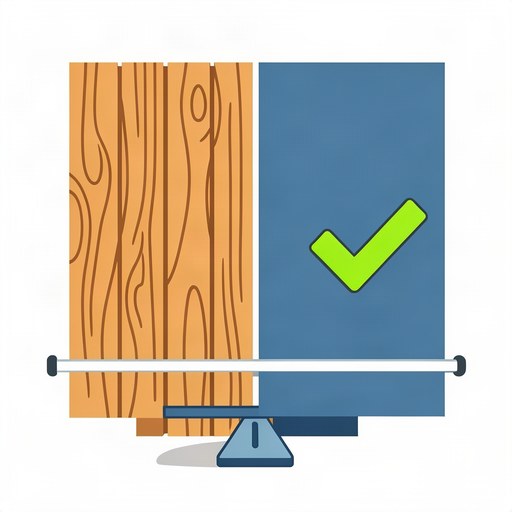
Verdict: Premium composite decking carries a 50-year exposure life. The pressure-treated frame beneath it begins functional degradation at 15 years — and crowns visibly by year 3. Because flexible composite permanently mirrors the wood, the surface inherits the wood's lifespan, not its own. A high-performance composite deck in Brownsville typically lands $15,000–$35,000; that money buys 50 years or 15 depending entirely on what holds the boards up. This is written for homeowners around Brownsville, TX who are looking into deck roof and want the honest version rather than a sales page.
This is not a warning about cheap decking. Every board in a wavy deck may be perfectly good. The wave is manufactured below it, in the joists, and it arrives on a schedule you can put a year on.
The short version
- Premium composite decking carries a 50-year exposure life while the pressure-treated frame beneath it begins functional degradation at 15 years and crowns visibly by year 3.
- The wave is mechanical transfer of warping rather than a product defect, since composite is flexible and permanently mirrors the wood, so no board in a wavy deck needs to have failed.
- The timeline runs day one flat, year three crowning as the joist twists and shrinks while it dries, year five a wavy deck across multiple joists, and year 15 when lumber degradation begins.
- Composite has no independent mechanism to relax back toward flat because it does not take on and release moisture as wood does, which is why re-screwing boards or sanding joints never removes the wave.
- Gulf humidity, driven rain and repeated wet-dry cycles accelerate the schedule, and a PT joist can still be structurally serviceable at year 12 while already crowned enough to wave the deck, since rot resistance and dimensional stability are separate properties.
- A wood-framed composite deck is maintenance-deferred rather than maintenance-free, and the scorecard rates PT at 15 to 30 years against 50+ years for G90 steel, whose flatness row reads dead-flat permanently.

The Lifespan Gap: A 50-Year Surface on a 15-Year Frame
Slide 02 opens with one timeline running 0 to 50+ years and two bars drawn across it. The top bar is premium composite decking — 50-year exposure life, drawn unbroken to the end of the axis. The bottom bar is pressure-treated (PT) lumber, and it is annotated with the single most important figure in the deck: functional degradation begins at 15 years. On the drawing the wood bar fades and breaks into a squiggle before the midpoint of the timeline; the composite bar is still going.
Two different lifespans, one assembly. The board and the joist are not selling you the same number of years, and the board is mechanically fastened to the joist. Flatness, appearance, maintenance timing, replacement timing — all of it defaults to the shorter number. A deck is not a surface with a frame under it. It is a frame with a surface on it, and the frame sets the terms.
The Physics of Failure: Mechanical Transfer of Warping
The natural assumption is that a wavy deck means defective composite. Slide 02 reframes it as mechanical transfer of warping — a load path, not a product defect. Composite is flexible. Wood moves. Put a flexible planar surface on a moving substrate and the surface takes the substrate's shape; the slide's own caption reads that flexible composite permanently mirrors the warped wood.
Nothing in the composite has to fail for the deck to look ruined. No cracking, no fading, no delamination, no warranty event. The surface simply records whatever geometry the joists hand it. And because composite does not take on and release moisture the way wood does, it has no independent mechanism to relax back toward flat. Wood can re-wet and partially recover its dimension; composite holds the line it was fastened into.
That single fact explains why the usual remedies fail. Re-screwing a board, sanding a joint, swapping out the worst plank — none of it touches the wave, because the plank and the board were both flat when they were new. The distortion lives one layer down.
Day 1 → Year 3 → Year 5: The Warping-Transfer Chain
Slide 02 walks the identical cross-section — composite board, wood joist, fasteners — through three dates. The chain runs: moisture leaves the wood, the wood changes dimension, the fasteners hold the composite in the wood's new profile.
| Point in time | What the wood frame does | What the composite surface does |
|---|---|---|
| Day 1 | Wood joist flat as installed | Composite board flat — the deck reads level and true |
| Year 3 | Crowning: the joist twists and shrinks as it dries | Board arches with the joist; the profile is no longer planar |
| Year 5 | Crowning now distributed across multiple joists | The wavy deck — flexible composite permanently mirrors the warped wood |
| Year 15 | Functional degradation of pressure-treated lumber begins | Surface is committed to the frame's geometry; no recovery path |
| 50 years | Well past the PT frame's service window; slide 07 rates PT at 15–30 years | Board still inside its 50-year exposure rating — on a frame that is not |
That is the whole argument in five rows. Note that the composite never appears as the failing element. It is flat on day 1, arched by year 3 in response to the joist beneath it, and carrying a wave at year 5 that came up from below. The deck's own labels name the mechanism on the wood, not the board: crowning is described as wood twisting and shrinking as it dries.
Year 5 is not the end of the process. It is the point where distortion stops reading as a seasonal or settling condition and becomes the deck's permanent geometry. The joists keep cycling, and the surface keeps recording.
Why a Gulf Coast Frame Runs Ahead of the Schedule
Wood moves because it gains and loses moisture, so the speed of this failure is a climate question. Brownsville supplies the cycle year-round: Gulf humidity, driven rain, and the repeated wet-dry swing of a coastal summer. Every cycle is another increment of twist and shrink transferred into the surface above.
The same environment attacks the frame biologically. Slide 03 states that cold-formed G90 galvanized steel is 100% impervious to moisture intrusion, fungal rot and wood-boring insects — precisely the three failure modes pressure-treated lumber is treated to delay rather than prevent. On the coast, delay is the operative word, and the two clocks are separate: a PT joist can still be structurally serviceable at year 12 and already be crowned enough to wave the deck. Rot-resistant and dimensionally stable are not the same property, and a wavy deck is a dimensional failure, not a rot failure.
Salt air sits on top of both, as an extra corrosion load on every fastener, hanger and connector in the assembly. It is the local case for the deck's specified galvanized, 16-gauge C-joist substructure — not a reason to keep treated lumber exposed to it.
Failure & Maintenance Truth: You Cannot Sand Out a Frame
Here is the part most deck marketing omits. A wood-framed composite deck is not maintenance-free; it is maintenance-deferred. The surface will never need staining, but the frame still needs inspecting, re-tightening and eventually replacing — and once crowning is established, the repair is structural rather than cosmetic. No surface treatment removes a wave cast by the joists.
Slide 07's own scorecard sets pressure-treated lumber at a 15–30 year lifespan against 50+ years for G90 steel, and it lists surface flatness as the trade-off: susceptible to crowning versus dead-flat, permanently. That is the trade-off a homeowner lives with, because it decides what happens in year 15 of a 50-year surface. You accept the wave; or you strip and re-lay boards that were still within their exposure rating; or you rebuild the frame underneath a surface that never needed replacing.
At the Brownsville price band — a high-performance composite deck typically lands $15,000–$35,000 — the frame is not the line item to shave. It is the line item that decides which of those two numbers you actually bought. Read what drives deck cost in Brownsville before you let a bidder compress it.
Homeowner & Contractor Check List
- On an existing deck, inspect from underneath and sight down the joist edges for twist and crown — a wavy surface is a symptom, not the defect.
- Date the wave: distortion appearing around year 3 and consolidating by year 5 is the classic crowning signature of a PT frame, not a board failure.
- Before re-laying composite over an existing frame, measure the joists for flat and level — new boards on crowned joists re-create the identical wave.
- On new builds, check how joists were stored and how wet they went in; lumber installed wet dries in place and transfers that movement upward.
- Confirm the substructure spec in writing — material, gauge, coating — and match it to the exposure rating of the surface you are buying.
- Put frame inspection and replacement timing in writing with your contractor instead of assuming it never arrives.
- Test your own baseline before you sign: the deck-building knowledge quiz covers frame-versus-surface basics.
The fix for a wavy deck is not a better board; it is a frame that does not move. Slide 03's specification for cold-formed G90 galvanized steel — laser-straight and dead-flat, with zero warping, shrinking, crowning or twisting over a 50+ year lifespan — is the only version of this structure that matches a 50-year surface.
If the surface you are buying is rated for 50 years, the frame has to belong to the same class of decision: dimensionally stable and immune to the moisture cycle that produced the wave in the first place. Start with an on-site deck quote in Brownsville, work through the deck-building checklist, and read the questions to ask a decking contractor before anyone sells you a board. Questions about the frame under your existing deck and what it will do to a composite surface? Call (956) 396-1755.
Want a Forever Frame deck priced for your yard? Tell us what you are building and we will connect you with Brownsville providers who work to these specs. Get matched with local providers → — or call (956) 396-1755. No obligation.