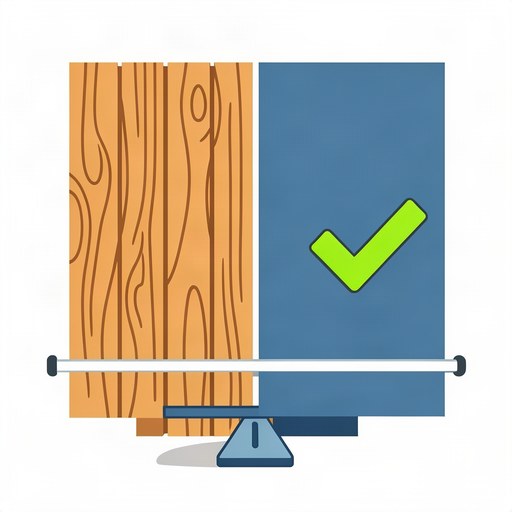
The scorecard decides it in five rows, and PT lumber loses every one. Steel frames are dead-flat permanently, span further, are Class A non-combustible, leach nothing, and carry a 50+ year lifespan against lumber's 15-30. You are already buying a 50-year premium composite surface — typically $15,000-$35,000 in Brownsville — so the frame under it should match that number, not undercut it. Same saw, same screws, same crew days. This is written for homeowners around Brownsville, TX who are looking into deck roof and want the honest version rather than a sales page.
What the Substructure Scorecard Is For
Slide 07 puts two things side by side: the installation workflow a crew actually runs, and a five-row scorecard that judges the frame on surface flatness, span distance, combustibility, toxicity and lifespan. It is not a ranking of brands. It is a discipline — five questions with one answer each, so a homeowner can hold a bid against something more durable than a contractor's confidence.
The short version
- The substructure scorecard judges a deck frame on five rows, surface flatness, span distance, combustibility, toxicity and lifespan, and pressure-treated lumber loses every one of them.
- Wood's functional degradation begins at 15 years while cold-formed G90 galvanized steel carries a 50+ year dimensional stability specification, a 35-year gap that frames the entire argument.
- Because a flexible composite board is mechanically bound to the frame beneath it, wood crowning becomes a wavy deck by year five, whereas G90 arrives laser-straight and stays dead-flat.
- Tight post spacing and dense joist grids in a PT frame produce a forest of posts, while steel's superior strength-to-weight ratio allows extended spans that eliminate mid-span supports and open the sub-deck.
- Steel is 100 percent non-combustible and Class A, acting as a firebreak against flying embers in Wildland-Urban Interface zones, and it is chemically inert with zero leaching while treated lumber depends on harsh chemicals that can leach into soil.
- The spec to demand in writing is 16-gauge C-joists with a G90 galvanized finish, deflection-resistant connections, integrated lateral bracing, and documented load calculations and soil bearing capacity before footings are laid.
Every row on that card maps to a failure mode with a date attached. Wood's functional degradation begins at 15 years. Steel's dimensional stability is specified across a 50+ year lifespan. That 35-year gap is the whole argument, and it is the reason a bid that quotes the surface carefully and the frame loosely is quoting the wrong half of the deck. Nothing on the card is a Brownsville measurement — the deck specifies the system, not the address — so treat it as the standard a local bid has to meet, not as a claim about your particular yard.

Five rows, two columns, one specification behind every steel entry:
| Criterion | PT lumber | G90 steel |
|---|---|---|
| Surface flatness | Susceptible to crowning | Dead-flat, permanently |
| Span distance | Restricted | Extended open space |
| Combustibility | Fuel source | Class A non-combustible |
| Toxicity | Chemical leaching | Chemically inert |
| Lifespan | 15-30 years | 50+ years |
Rows 1 and 2: Flatness and Span Are the Rows You Can See
Surface flatness is the row that costs you the surface. A composite board is flexible; it is mechanically bound to the frame beneath it, so the frame's shape becomes the deck's shape. The deck's own failure timeline is blunt about the mechanics: Day 1, the composite board is flat over a flat wood joist; Year 3, crowning appears as the wood twists and shrinks while it dries; Year 5, you have the wavy deck. Nothing in that sequence is the board's fault. The steel column reads dead-flat, permanently because cold-formed G90 arrives laser-straight and holds it — no warping, shrinking, crowning or twisting across the rated lifespan.
Span distance is the row that costs you the space under the deck. A traditional PT frame requires tight post spacing and dense joist grids, and that density produces the "forest of posts" that limits usable ground space. Cold-formed steel's superior strength-to-weight ratio allows extended spans, which eliminates mid-span supports and unlocks the sub-deck for outdoor living. On a Brownsville lot, that is the difference between a deck you can only walk on top of and a deck with a shaded patio, a storage bay or seating underneath. It is also the row most often quietly deleted from a bid to keep the number low.
Rows 3 Through 5: Fire, Chemistry, and the 15-to-50-Year Gap
Combustibility reads fuel source against Class A non-combustible. Steel is 100% non-combustible: it will not ignite, melt, or contribute fuel to a fire, and it acts as a critical firebreak against flying embers in Wildland-Urban Interface zones. A treated wood frame does the opposite — it is the material a fire feeds on. In a WUI-designated area, that single row can drive an approval decision.
Toxicity is the row nobody asks about until there is runoff. Traditional pressure-treated lumber relies on harsh chemical treatments to delay rot, and those treatments can leach into backyard soil. Steel is chemically inert with zero leaching. The same row carries the biology: cold-formed G90 is specified as 100% impervious to moisture intrusion, fungal rot and wood-boring insects — the three failure inputs a Gulf Coast backyard supplies for free, year after year, with no maintenance break.
Lifespan is where the other four rows land. Wood: 15-30 years. Steel: 50+ years. Put that beside a composite surface rated for a 50-year exposure life and the mismatch is arithmetic — you would be scheduling a structural replacement under a deck surface that is still inside its own rated life. The deck's cost curve makes the same point financially: wood's cumulative line climbs steeply across the 50-year window while the steel line runs lower after the convergence point, because wood carries a hidden subscription in maintenance and guaranteed replacement cycles that steel, as a one-time lifetime investment, does not. On a $15,000-$35,000 build, the frame is where the second invoice hides — the full breakdown is at deck building cost in Brownsville.
Labor Parity: the Half of Slide 07 That Protects Your Bid
The scorecard is only half the slide. The other half claims labor parity, and it earns that claim with tooling, not with a slogan: modern steel framing systems are engineered for the tools your crew already owns — a standard metal-cutting blade and self-tapping screws. No specialty equipment, no exotic license to cut it. Lighter weight and perfectly straight pieces eliminate the hours normally wasted sorting and planing warped wood.
That matters to your budget in two places. First, a steel frame should not carry a labor premium over a wood frame, since the crew is cutting and fastening with the same class of tools on both. Second, straight material is prep time you never pay for: every hour a carpenter spends sorting, shimming or planing a crowned joist is an hour on your invoice that produces no deck. Ask for the labor line in writing, and ask what the crew is cutting with.
What You Can Check Yourself
None of these require a license, and all of them are visible before the surface goes down:
- Sight down the joists. Stand at one end of a joist run and look along it. Wood shows crown, twist and shrinkage gaps; steel should show a laser-straight line with no planing marks and no shim stacks.
- Ask the gauge and the coating by name. The deck specifies 16-gauge C-joists with a G90 galvanized finish. If the bid says "steel frame" without those two identifiers, it is a category, not a specification.
- Ask how the pieces are held together. Self-tapping screws, deflection-resistant connections at the load points, and integrated lateral bracing — bracing designed into the frame, not bolted on afterward.
- Ask for the numbers before the footings. Soil bearing capacity and the load calculation should exist before footing layout, not after a problem appears.
- Match the two warranties. Put the surface's 50-year rating next to the frame lifespan the bid promises. If those two numbers disagree, you have found the weak link — and the deck building checklist will keep it from getting buried in the paperwork.
If you would rather test your own instincts first, run the deckbuilding knowledge quiz and see whether you can spot a restricted-span frame in a bid before we do.
The Spec Lines to Hand a Contractor
Copy these eight lines into the message when you request bids. They are the scorecard translated into build language:
- Cold-formed steel substructure, 16-gauge C-joists, G90 galvanized finish.
- Deflection-resistant connections at every joist-to-beam interface.
- Integrated lateral bracing engineered into the frame.
- Extended-span layout with no mid-span supports where the design allows, to keep the sub-deck open.
- Documented load calculation and soil bearing capacity before footing layout.
- Helical pile footing integration reviewed by an engineer.
- Class A non-combustible framing assembly, chemically inert with zero leaching.
- Delivery standard: dead-flat and laser-straight at arrival, with 50+ year dimensional stability specified in writing.
Where This Goes Next
The deck's own next steps are the sequence to expect: site evaluation and span optimization, an engineering review for helical pile footing integration, and a finalized "Forever Frame" proposal. That order is deliberate — spans get solved before footings get placed, so the frame is not designed twice. Come to a bid with the eight spec lines above and the conversation stops being about brand and starts being about numbers, which is exactly where a $15,000-$35,000 deck should be decided. Have your contractor questions ready, request your Brownsville deck quote, and we will run the scorecard against your site rather than against a brochure.
Brownsville deck building — call (956) 396-1755 and ask for the substructure scorecard on your estimate.
Want a Forever Frame deck priced for your yard? Tell us what you are building and we will connect you with Brownsville providers who work to these specs. Get matched with local providers → — or call (956) 396-1755. No obligation.